In this series, you can find pieces that introduce classical guitar with increasing levels of difficulty. For those who cannot read notation or do not wish to learn, tablature is also included in the PDF file.
You can find the YouTube video for each piece. You can access videos by clicking on the image of the piece.
You may click the link below the image to view and download the PDF that contains the notation and tablature.
In addition, the PDF file includes a YouTube link and a QR code that allows you to access the video. If you are practicing the piece on a computer or tablet, you can access the video by clicking the YouTube link in the PDF file. When printed, you can simply scan the QR code with your phone to open the video.
Divertissement
This piece by Antoni Cano-Curriela, which is a popular starting point for many classical guitarists, is not only melodically beautiful but also highly educational.
You can also access the video by using the YouTube link or the QR code provided in the PDF.

Window
A piece by Murat İşbilen. It is ideal for learning basic chord transitions and developing arpeggio technique.

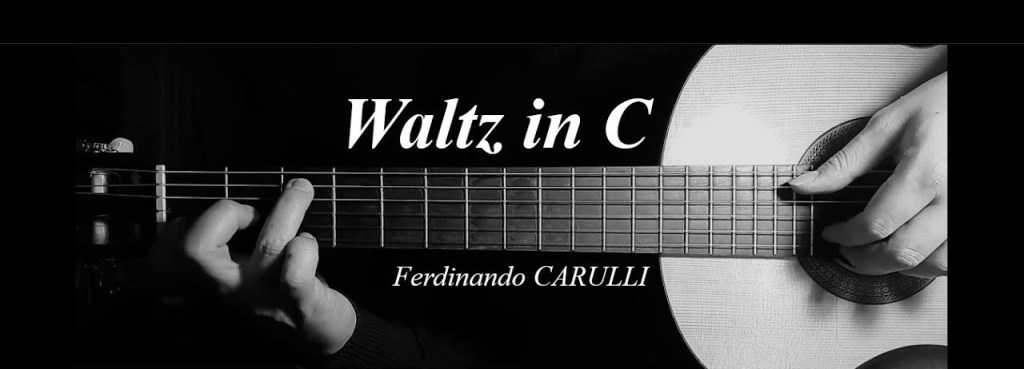
Waltz in C
Carulli’s pieces, known for their melodic clarity and pedagogical structure, remain popular today among beginners and intermediate guitar players.
With this waltz written in C major, we learn how to play two strings at the same time. These two strings may appear either as two treble strings or as one bass string and one treble string.
Visual explanations are provided in the PDF.
Waltz in G
We continue with another waltz by Carulli. In this piece, you can observe how left-hand finger numbers are placed strategically in classical guitar playing. Fingerings that may seem meaningless at first will make sense once you consider the following measures.
Pay special attention to the position shift in the final staff. It is important to press some of the notes simultaneously.

Prelude
This prelude by Carcassi is far more than an exercise that supports technical development. With its melodic depth, it is a piece you can comfortably perform for listeners who are curious about your guitar playing.
Additionally, you can practice it as a speed-building exercise by gradually increasing the tempo with a metronome.

Allegro
This piece, which has a theme similar to the prelude, begins with the same arpeggio used at the end of the prelude, as you may notice. In the second measure, unlike the first, we play the melody on the bass strings with the p finger while sounding the accompaniment note with the i finger.
One of the most important aspects of this piece is the position shifts. In particular, the position shift in the seventh measure, where we press the bass string with the fourth finger of the left hand, is the most challenging. At the same time, it is also the one that will help you improve the most.
Further details are provided in the PDF.

Asturias
If you have been interested in classical guitar before, you have most likely heard this piece. It was originally composed for piano and later arranged for guitar by Andrés Segovia.
I am sharing a highly simplified version of this unique work with you.

Stay tuned for more…
