In this collection, you will find exercises that are mixed and not bound to any particular order. With its variety of styles, this series is designed to provide a diverse and colorful set of exercises.
The YouTube video for each exercise can be accessed by clicking on its image.
You may click the link below the image to view and download the PDF that contains the notation and tablature.
In addition, the PDF file includes a YouTube link and a QR code that allows you to access the video. If you are practicing the exercise on a computer or tablet, you can access the video by clicking the YouTube link in the PDF file. When printed, you can simply scan the QR code with your phone to open the video.
The Call of Ktulu
This piece, considered one of Metallica’s classics, is not only known for its powerful melody but also serves as a valuable arpeggio exercise. The rapid position shifts in the left hand and the chromatic movement on the third string in the final arpeggio section make it a useful study in polyphonic playing. I highly recommend starting at a slow tempo, especially in the beginning.
You can access the performance of this exercise on YouTube by scanning the QR code or clicking the link below it.

Rumba Arpeggios
A beautiful rumba arpeggio from Paco Peña’s Herencia Latina. I’ve always been fascinated by how African and Spanish roots, enriched by the elegance of Baroque influence. It’s an enjoyable exercise to practice at both slow and fast tempos. Pay close attention to the right and left hand fingering.
Scan the QR code or use the link below it to watch a performance of this exercise on YouTube.
Quadruple Tremolo Exercise
This advanced exercise features a tremolo passage from Paco Peña’s Soleá. It uses a different combination of the index (i), middle (m), and ring (a) fingers—a technique commonly found in flamenco. Unlike the classical guitar tremolo pattern p-a-m-i, this variation adds an extra i to create p-i-a-m-i, enhancing the sense of continuity in the tremolo.
Scan the QR code or use the link below it to watch video of exercise. You’ll find a tutorial in the second half of the video.
Rumba Pulgar & Rasgueado Exercise
Here’s another exercise from Paco Peña’s Herencia Latina. While learning a beautiful rumba intro with the thumb, you’ll also be practicing the transition between thumb playing and rhythmic accompaniment. This technique, which blends solo and rhythm parts, adds great color to your individual performance and provides an excellent foundation for improvisation.
Orion (intro)
A palm mute exercise with a pick, based on the intro of Orion. In the final section, you’ll need to apply palm muting rapidly on quarter notes. Start practicing at a slow tempo.

Rasgueado Exercise & Tutorial
I wrote this exercise during a period when I was getting bored of practicing the rasgueado technique on open strings. It’s designed to remain enjoyable even when repeated multiple times. This way, you can develop a better sense of coordination between finger strokes and the resulting sound.
In the second part of the exercise, we also work on the golpe technique. I imagined the golpe as a steady, metronome-like background pulse, and designed the rasgueado strokes to fit around it accordingly. The most critical point here is synchronizing the movements: while the index finger (i) performs a downstroke, the ring finger (a) should execute the golpe at the exact same moment.
A detailed demonstration of this technique can be found in the video.

Warm-Up Exercise
This exercise, designed by Safa Yeprem, can be a great warm-up. Take note that the little finger is also used in the arpeggio.
Watch the YouTube performance via the QR code or the link below.

Solea Falseta
You can practice both arpeggio and rasgueado techniques in this characteristic soleá falseta.
In the first section, to play the triplets smoothly with the i-m-a fingers, place all three fingers on their respective strings in advance, then release them in quick succession.
In the final section, pay close attention to the fingerings during the sweeping motion across all six strings. I recommend studying this passage with the help of the video. To watch the video, scan the QR code in the PDF or click the link below it.

Improvisation
This piece was composed on an evening when the muses were with me. It offers a practical exercise in arpeggios and chord transitions.

Once Upon A Time In Mexico
Once Upon a Time in Mexico is another favorite for Desperado fans, right after Canción del Mariachi.
I arranged this piece by starting with the original melody in the intro, then added a new theme that matches the overall character of the composition. It’s designed to be played within the chords, blending melody and rhythm to create a two-guitar feel on a single guitar.
To better understand the rhythm section, I recommend watching the video at a slower playback speed while following along with the tabs. With a bit of focus and patience, you’ll see real progress.

Picado Exercise on Impetu
This piece from Impetu, a composition by Mario Escudero, is an excellent exercise for developing your picado technique. As you shift from the first to the fifth fret, it offers a clear opportunity to practice efficient finger placement and position control.
Once you begin to raise the tempo, you’ll start to feel the Andalusian spirit come alive.
Stairway to Heaven
The fingerstyle arrangement of the vocal section in Stairway to Heaven is by Gabriella Quevedo. I’ve always admired her version, so I transcribed the tabs and used it as an intro leading into the solo.
The solo section that follows in the video is inspired by the arrangement from Rodrigo y Gabriela. If you’re interested, I can write the tabs for the solo part in the PDF as well. Let me know via email or by leaving a comment on the YouTube video.

Guaranteed
One of the most popular tracks from the Into the Wild soundtrack, this piece also serves as a highly effective arpeggio exercise. Its polyphonic structure makes it enjoyable to play over and over again.
With respect to Alexander Supertramp and Eddie Vedder.

Roma
This special piece by Vicente Amigo shows how impressive results can come from basic techniques.
When I first started working on this piece, it seemed to have a simple arpeggio. But after just a few bars, I was surprised by how different it felt from the original.
The secret lies in one of the most fundamental techniques in flamenco guitar: downstrokes and upstrokes. These slight movements, placed at the end of the arpeggio cycle, bring rhythm and soul to the piece.
On the other hand (I mean it literally), there are some challenging positions on the left hand, but with mindful practice, they are absolutely manageable.
May you one day play this under a setting sun, beside a lighthouse.

Tangos Final
This remate by Safa Yeprem shows an impressive combination of picado and rasgueado techniques. In the YouTube video, it’s first performed at full speed, then repeated at a slower tempo with a metronome for easier study.
Rumba Exercise From Paco Peña
If you’ve completed the Rumba Arpeggios and Rumba Pulgar & Rasgueado Exercise, you’re ready to move on to this one.
In this exercise, you’ll be working on a falseta from Paco Peña’s Herencia Latina, where you can practice picado, rasgueado, and arpeggio techniques, all guided by Paco Peña’s beautiful melodies.
İstiklal Marşı
The İstiklal Marşı (Turkish National Anthem), originally composed by Osman Zeki Üngör, is presented here in a guitar arrangement by Safa Yeprem. Following a rasgueado introduction, the piece flows with rich harmonies shaped by the contrast between bass and treble lines.
It brings me great joy to see how naturally my national anthem finds its voice on the guitar.

Picado Exercise
A picado exercise built on two different scales, each ending with a different chord. If you’re already confident with picado but have just started combining rasgueado with other techniques, this can be a very effective practice.
Feel free to slow down the rasgueado section at the end of each scale if needed.
You’ll find both a fast and a slow-tempo version in the YouTube video.
Pulgar Exercise on Santuario
A friend once told me about a flamenco performance he attended during a trip to Spain. The guitarist was playing so brilliantly that he didn’t even realize—until he focused on the player’s right hand—that the entire piece was being played using only the thumb.
That’s how powerful pulgar technique is important.
I highly recommend this thumb-driven section from a piece by Paco Peña.
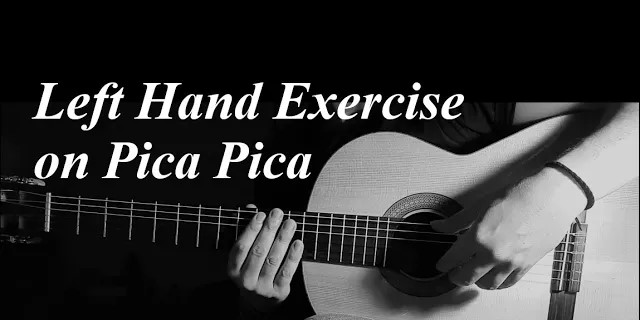
Left Hand Exercise on Pica Pica
This piece is anonymous, meaning its title likely evolved over time through popular use. In traditional music, names often come not from a specific composer, but from how a piece is felt, heard, or remembered by the community.
The name “Pica Pica” fits beautifully. In Spanish, it captures the lively, energetic mood of the music and echoes the rhythmic spirit often found in folk traditions. Interestingly, it also shares its name with the Eurasian magpie (Pica pica), which adds a cheerful, nature-inspired layer to the piece. Its playful, percussive sound makes the title both memorable and a perfect match for the character of the music.
The following section, taken from the second part of the piece, can serve as an excellent left-hand exercise. Hearing the beautiful blend of bass and treble tones provides more than enough motivation to deal with the challenges of this demanding passage.
A slower version is added at the end to help you follow along.
Picado Exercise on Pharaon
This instrumental piece by the Gipsy Kings includes legato, picado, and pulgar techniques. The focus of this exercise is on the picado-heavy section, but you’ll also find parts where pulgar is used effectively.
In addition to picado, the legato passages provide an excellent challenge for your left hand.
The only side effect? A bit of finger and hand tension (which I like), but it’s definitely worth it.
The video ends with a slow-tempo version for easier practice.

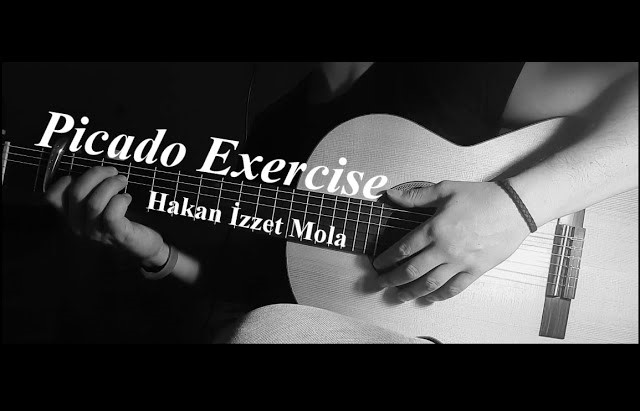
Picado Exercise
This exercise is designed to develop your ability to use picado technique in a vertical direction, moving from bass strings to trebles and vice versa. You’ll spend time on both bass and treble strings before shifting along the vertical axis.
Pay close attention to the right-hand thumb: when playing on the bass strings, it should rest lightly against the guitar body, and as you move toward the treble strings, be mindful of its movement to lean back toward the sixth string.
You’ll find a slowed-down version at the end of the video as well.
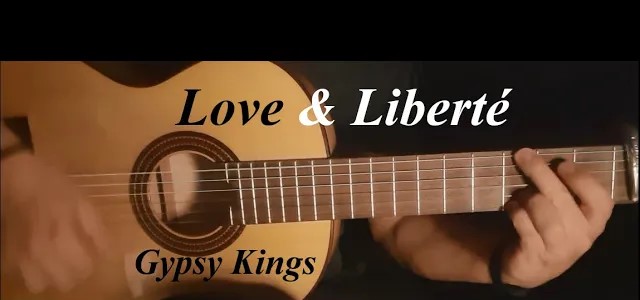
Love & Liberte
You can find the tabs for the chorus section of this beautiful piece by the Gipsy Kings below.
Pulgar Exercise on Farruca
A pulgar exercise based on Oscar Herrero’s Farruca.
Simple, effective, and enjoyable.

Tangos Exercise & Tutorial
Tangos, one of the most well-known palos in flamenco.
You can find a tutorial on its basic form in the video. I recommend practicing with a metronome at first, rather than using the compás.

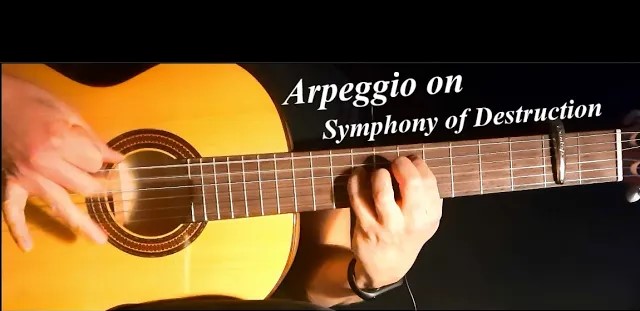
Arpeggio on Symphony of Destruction
How does metal music sound on a nylon-string guitar without a pick?
You won’t know until you try.
I came up with an arrangement using arpeggios and up & down strokes, and I really enjoyed playing it. I hope you’ll enjoy it just as much.
You can find a tutorial for the arpeggio section at the end of the video.
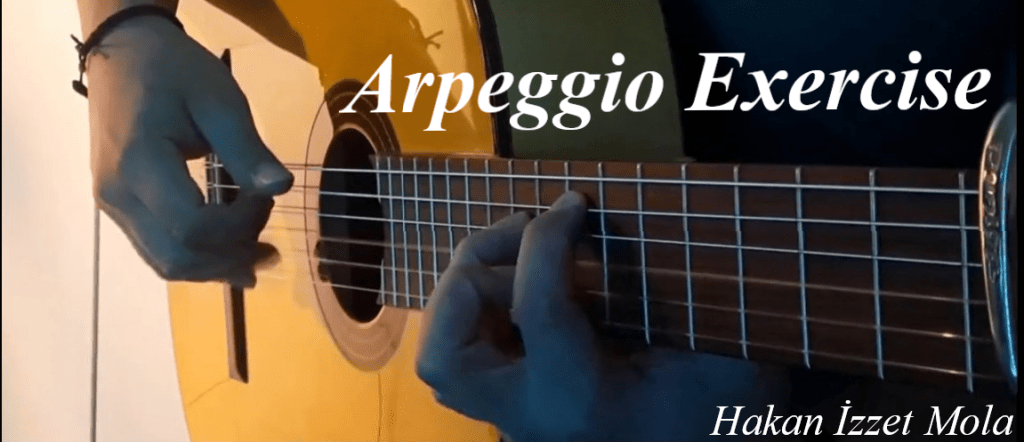
Arpeggio Exercise
This exercise, which I composed using the open positions of the Em, D, C, and B chords, can be used as a simple, clear, and effective arpeggio exercise. It is also ideal as a finger warm-up routine.
Picado Exercise
One of the most striking techniques in flamenco guitar is the picado. In an interview, Paco mentioned that he used the picado technique to excite the audience.
I recommend watching this exercise video at a slow tempo and paying close attention to which finger (i or m) starts each passage. Also, be mindful of the staccatos.

Stay tuned for more…
