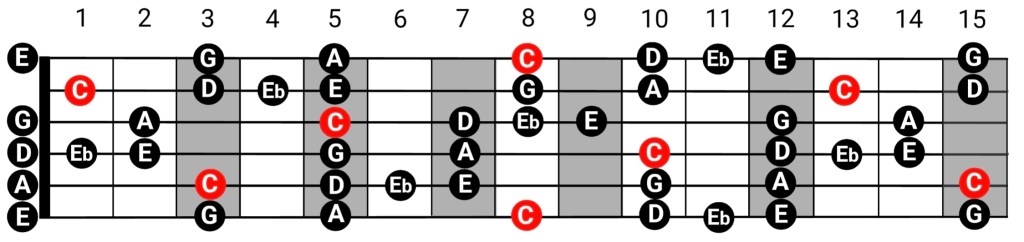
The pentatonic scale takes its name from the Greek word penta, meaning “five.” As the name suggests, this scale contains five different notes within each octave. Compared to the seven-note major and minor scales, it has a much simpler structure.
This simplicity is actually its greatest strength. Since it does not contain half steps, it always sounds consonant and the chance of hitting a wrong note is almost eliminated. For this reason, it has appeared independently across many different cultures around the world. From China to Scotland, from Africa to the Americas, pentatonic scales form the foundation of much traditional folk music.
In many rock, blues, metal, and pop songs, these scales form the foundation of the solos. For beginners on the guitar, the pentatonic scale is indispensable because it is both easy to learn and highly practical in use.
Main Types of the Pentatonic Scale:
- Major Pentatonic Scale
- Minor Pentatonic Scale
- Blues Scale Scale
Major Pentatonic Scale
The major pentatonic scale is essentially a simplified version of the major scale. By removing the 4th and 7th degrees, the remaining five notes form the major pentatonic scale. Removing just two notes from any major scale makes it much more consonant. Since the 4th degree and the 7th degree are left out, the intervals that normally create tension are eliminated.
Major scale:
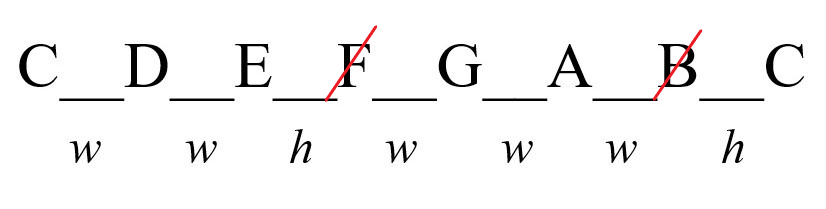


Major pentatonic scale:

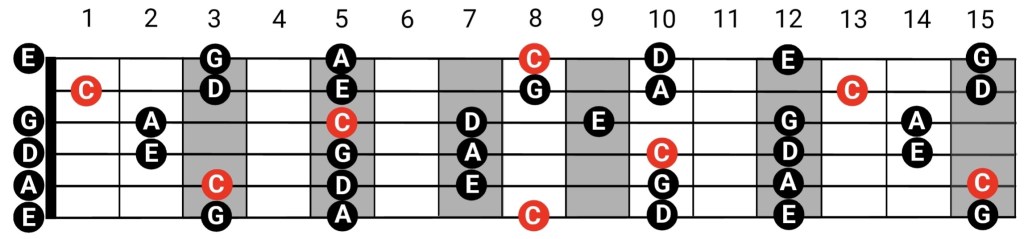

The major scale is reduced to these degrees: 1 – 2 – 3 – 5 – 6
In a piece written in a major key, playing a solo with the major pentatonic scale instead of the full major scale is much safer, especially if you are improvising or just beginning to play solos. This is because the risk of hitting a wrong note is greatly reduced.
While a C major backing track is playing in the background, try exploring the C major pentatonic scale:

Minor Pentatonic Scale
Just as the major pentatonic is derived by simplifying the major scale, the minor pentatonic is formed by simplifying the natural minor scale. When the 2nd and 6th degrees are removed from the natural minor scale, what remains is the minor pentatonic scale.
Natural minor scale:


Minor pentatonic scale:


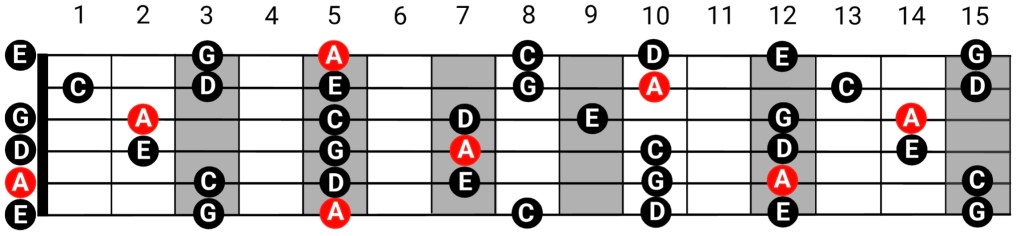
The natural minor scale is reduced to these degrees: 1 – 3 – 4 – 5 – 7
While a A minor backing track is playing in the background, try exploring the A minor pentatonic scale:

Blues Scale
Minor Blues Scale
If the flat fifth (♭5) from the natural minor scale is added to the minor pentatonic, the result is the blues scale.
Minor Blues Scale:

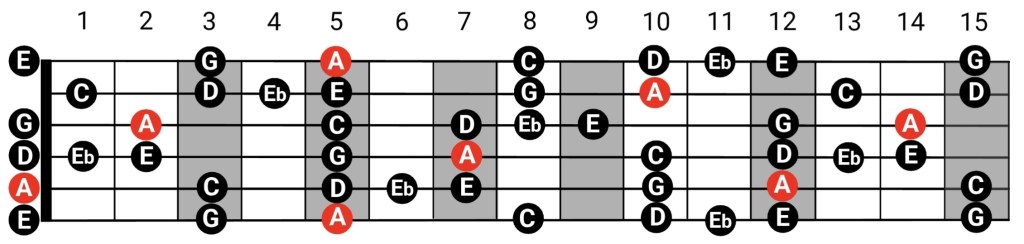

While a A minor backing track is playing in the background, try exploring the A minor blues scale:

Major Blues Scale:
We obtain the major Blues scale by adding the flattened third to the major pentatonic scale.
Major Blues Scale: