The major scale is one of the most fundamental structures to have evolved in both Western and some Eastern musical traditions. It is especially prominent in Western classical music, as well as in pop, rock, jazz, and film scores. It produces a bright and cheerful sound:
- Sweet Home Alabama
- Let It Be
- Eine Kleine Nachtmusik
- Happy
- Beautiful Day
- Star Wars Main Theme
Even the song titles sound cheerful. For Star Wars fans: May the scales be with you : )







Major scale pattern:
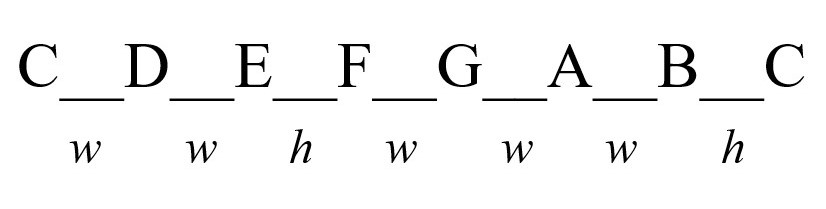
Whole – Whole – Half – Whole – Whole – Whole – Half
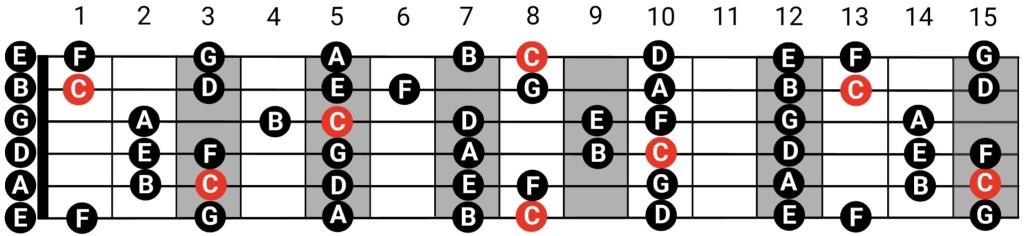
If we start from C and apply the major scale pattern (w – w – h – w – w – w – h), we get the following sequence of notes:

If we take E as the starting note and apply the major scale formula (w – w – h – w – w – w – h) beginning from E:
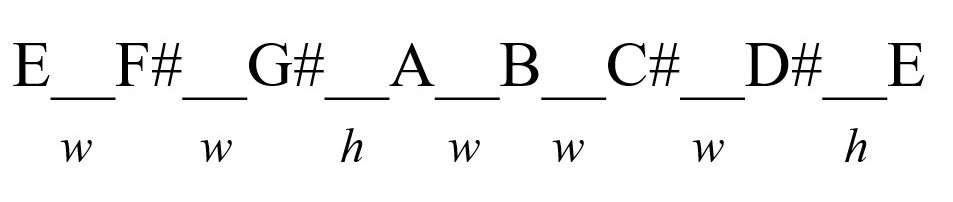
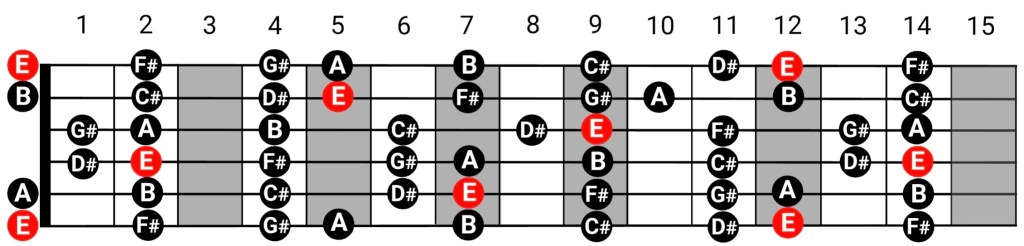

As you can see, some notes take on a sharp sign. As we mentioned earlier, E–F and B–C are naturally half-step intervals. When we apply the major scale formula starting on E, the first step is a whole step. This means we can’t move from E directly to F; instead, we land on F#.
What matters here is not the individual notes themselves, but the relationships between them. To create the major scale feel, each note shifts closer or farther according to the step pattern of the formula.
If we take G as the starting note:

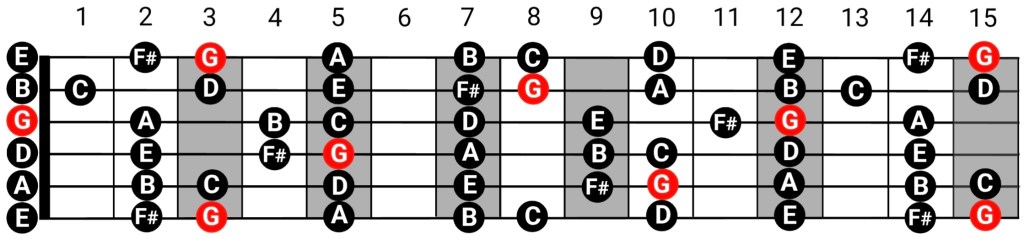

You can create the other scales by applying the major scale formula to different root notes. I recommend practicing each one directly on the guitar.
Another useful exercise: you can practice scales in your own way by using diagrams that show how the scale is laid out on the guitar fretboard. Notice that the root note of each scale is marked as a square, while the other notes are shown as circles. To move from one root note (square) to the next, you can trace your own path across the fretboard.
In the example below, I reached the root notes (C) in the C major scale by following a path I chose:
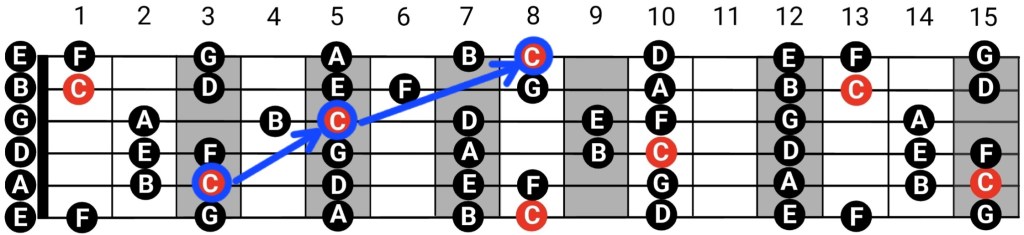

You can also take different paths between other C notes. Later, you can practice scales that begin on different root notes, such as G major or E major. The effect will be greater than you might expect.
The most important thing here is to practice with awareness. Setting a goal such as “I will go back and forth between two root notes three times without mistakes” and then expanding this by adding more repetitions or trying between different root notes is a good example of deliberate practice.
Practice smart!
