Chord Tablature on the Guitar
Just as the set design in a theater production draws us into the performance and supports the story portrayed by the characters, chords serve the same function in a piece of music as the set does in theater.
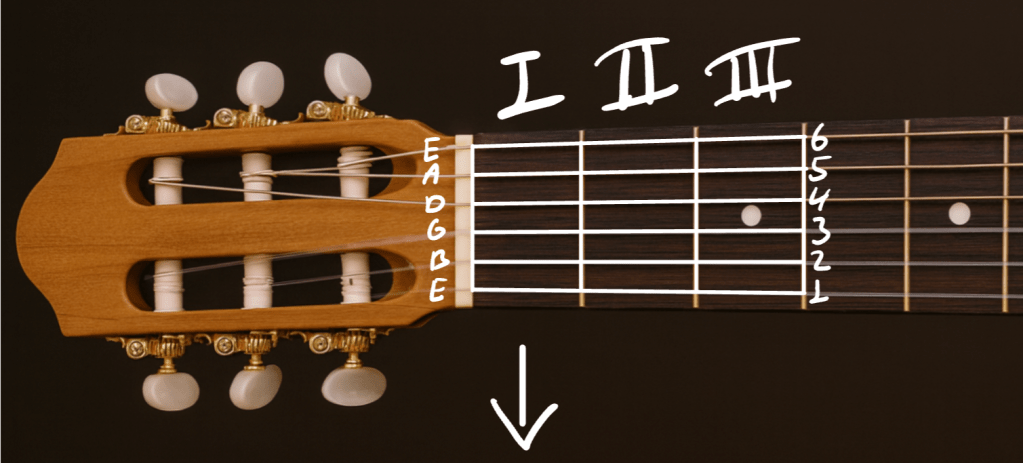
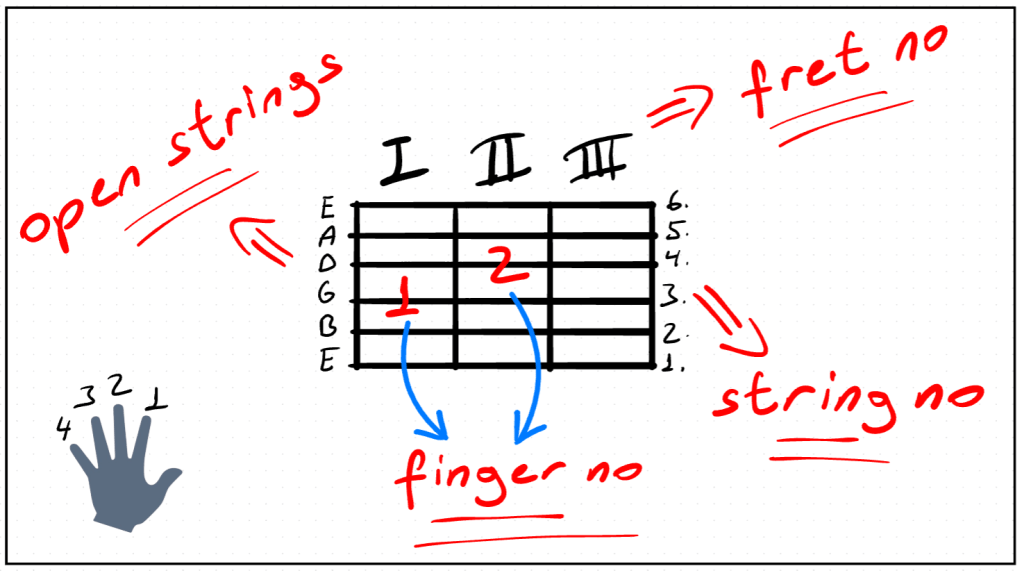
To be able to play chords on the guitar, we need a system that shows specific finger positions for the left hand. This system is very similar to tablature. In the tablature system, the sixth string is shown on the lowest line, while in the chord tablature system, the sixth string is shown on the top line. Simply put, in the chord tablature system we imagine looking at the guitar fretboard as if we were seeing it in a mirror:
How to Name Chords
We use Latin letters to name chords. As you can see in the table below, each letter corresponds to a note. It is important that you learn this table:
| C | D | E | F | G | A | B |
|---|---|---|---|---|---|---|
| Do | Re | Mi | Fa | Sol | La | Si |
I will provide much more detailed explanations about how chords are constructed in music theory, but at this point it is enough to know that chords are named according to the note they start with. If a chord begins with the note A, we call it an A chord. If it begins with E, we call it an E chord. If it begins with D, we call it a D chord.
So what is the starting note? It is the first note of the chord on the bass strings:
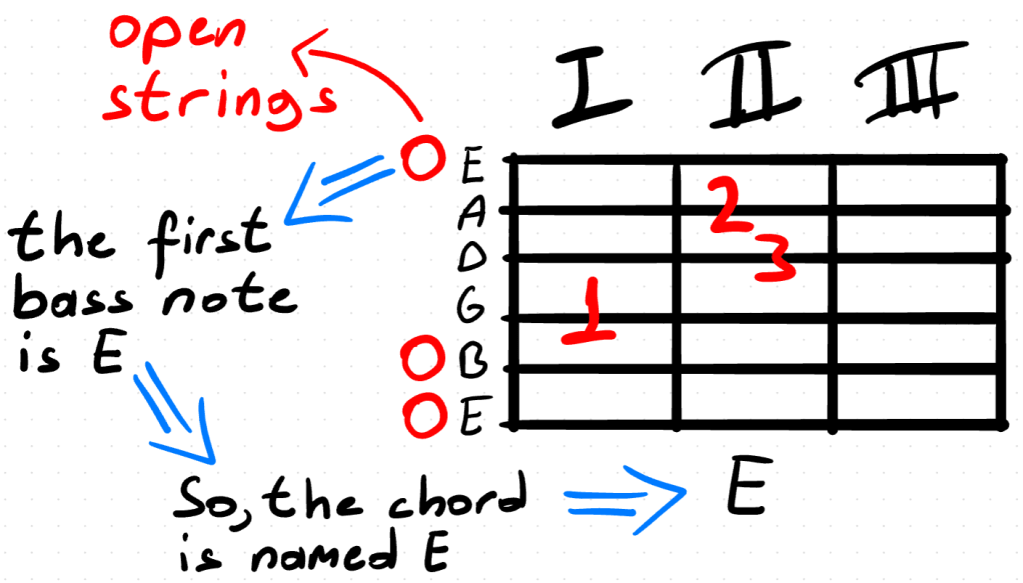
We said that the bass note is the first note where the chord begins. In the example above, we started the E chord on the sixth string because the first bass note on that string is E.
However, in some chords we do not play certain bass strings. The reason is that the open strings may contain notes that are not part of the chord, or even if they are, they may make the chord sound too crowded. We will cover this in detail in the theory section.
Here is your example:
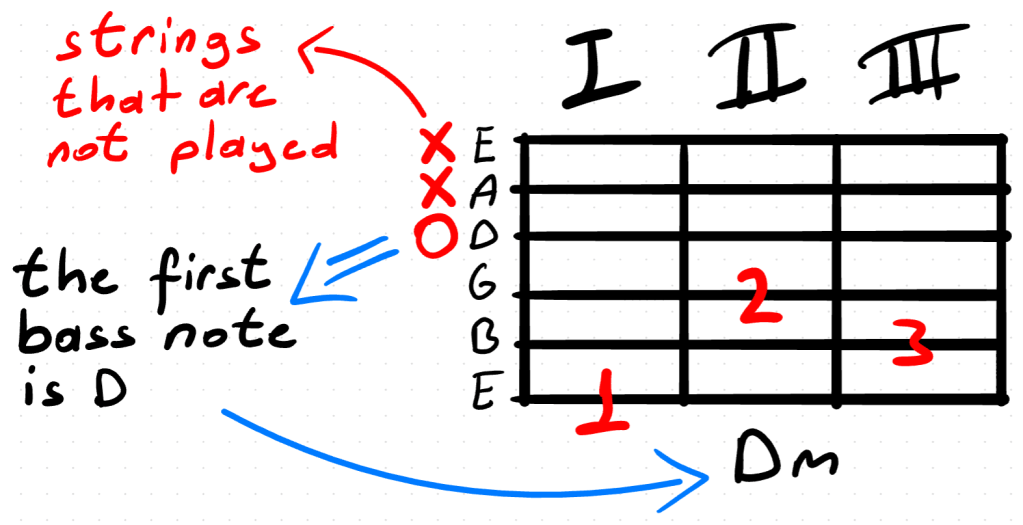
If you noticed, the E chord in the first example is written simply as “E,” while the D chord is written as “Dm.” The reason is that when reading chords, we divide them into two types: major and minor:
Major and Minor
Basically, major chords create a cheerful feeling and minor chords create a sad one. Even without thinking about the theory behind them, you can understand whether a chord is major or minor just by noticing how it makes you feel. Focusing on the emotion it gives you will be enough.
When it comes to reading the name of a chord, if there is nothing next to the letter, such as in the A chord, it is read as an A major chord. If there is an “m” next to the letter, such as in the Em chord, it is an E minor chord:

This is how we read chords.
Now play these two chords on your guitar and focus on how A major and E minor make you feel. You will clearly understand the difference between major and minor.
