Flamenco music is not merely about rhythm and technique. Born in Andalusia, it emerged as the product of a region where Eastern and Western cultures have intersected throughout history. The blending of Arab, Berber, Jewish, and Iberian traditions within this cultural melting pot shaped the modal richness of flamenco and gave it a structure that cannot be reduced to a single musical form.
Through this fusion, flamenco developed a hybrid character that integrates elements of both modal and tonal systems. At times, one can sense the vertical, chord-based nature of European harmony, while at other moments, melodic inflections rooted in Middle Eastern and North African traditions take precedence. The flexibility of the flamenco scale arises precisely from this historical and cultural depth. What truly makes it unique is the distinctive harmonic landscape created by its modes and cadences. At the heart of this musical world is the Phrygian mode, often referred to as the “flamenco scale.” However, this structure operates differently from the Phrygian mode found in classical theory, following its own set of rules within the flamenco tradition.
Just like the blues scale contains one additional note compared to the standard pentatonic scale, a similar situation is observed in the flamenco scale. The Phrygian mode, which we will examine in detail when discussing the Greek-derived modes, forms the core of flamenco. In addition to this, the harmonic minor scale that we mentioned earlier also appears within the flamenco scale. But the subject goes a bit deeper : )
So let’s take it step by step:
Remember the C major scale:

If we take E instead of C as the starting note, we obtain:
E Phrygian

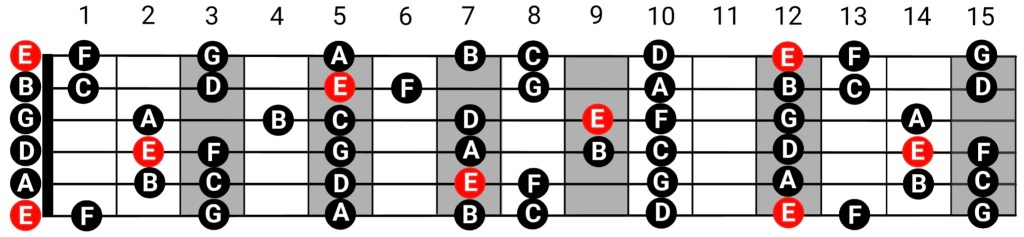

E Phrygian holds a central place in flamenco, but it does not appear on its own. Instead, it blends with other minor structures to create a traditional and characteristic color.
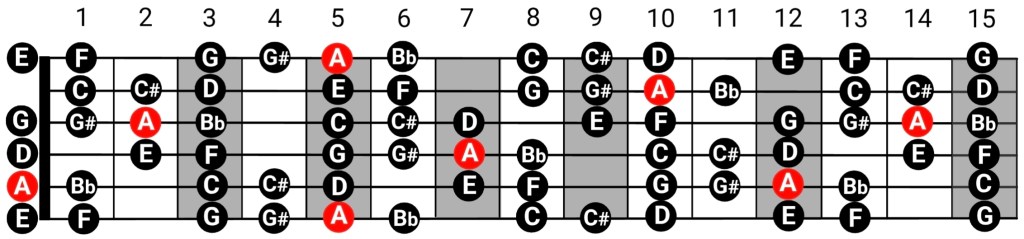
Here is A harmonic scale:

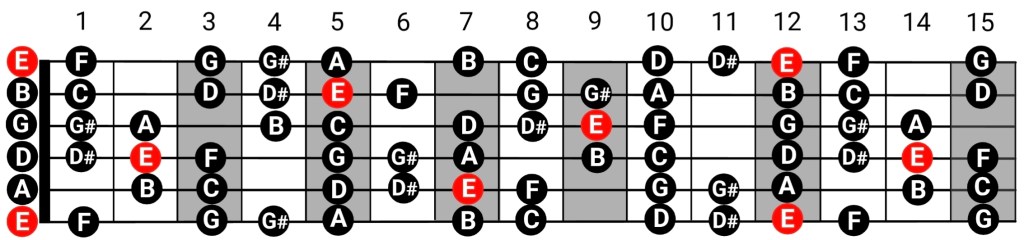
If we start the A harmonic minor scale on its fifth degree, E, we obtain E Phrygian dominant. This gives us an additional G♯ compared to the standard Phrygian scale.
E Phrygian Dominant



As you know, the Andalusian cadence uses the chord progression Am–F–G–E. What is interesting here is that we end the cadence with an E major chord instead of an E minor chord. This difference comes from the G♯ borrowed from the E Phrygian dominant scale.
Another noteworthy point is that instead of resolving back to Am at the end of the cadence, we stay on the E chord. In this context, the E chord functions like a tonic. Because of this tonic behavior, it deserves a leading note, which is D♯.
By combining E Phrygian, E Phrygian dominant, and the leading note (D sharp), we obtain the nine-note Por Arriba scale:
Por Arriba




When we follow the same steps using A Phrygian and A Phrygian dominant, we obtain the Por Medio scale:
Por Medio