The chromatic scale is the sequence of all twelve equally spaced notes used in Western music. It includes every half step (semitone), making it the foundation of the smallest standard interval in tonal music. Each note is a half step away from the next. For example, if we begin on C:

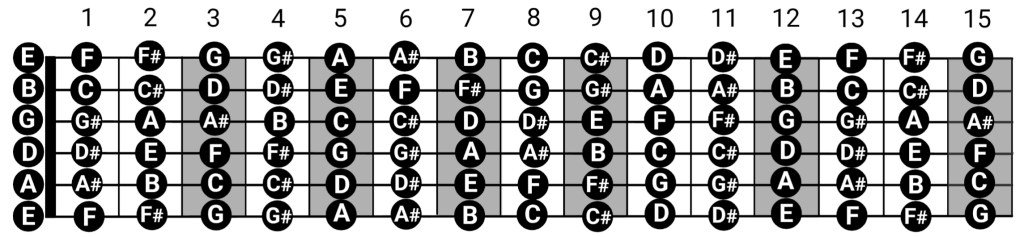

This scale can be constructed starting from any note by applying the same logic. As a result, the chromatic scale has a cyclical structure: after B, it returns to C, and this cycle can continue endlessly.
It is frequently used in beginner guitar exercises. It is ideal for helping each finger get accustomed to the fretboard and for developing proper positioning.
The chromatic scale is used to move away from a tonal center or to shift into a new tonality (modulation). It is especially effective in transition chords, offering the composer a wide palette of colors. In melodies, chromatic passages are often employed to create tension or to add intensity and expression. Since it contains all possible notes, it is not tied to a single tonal center. This gives the composer or performer great freedom: