There’s something I often notice during first-time lessons with students who are picking up the guitar for the first time. Even though they’ve never held a guitar before, many of them display surprisingly similar movements and grips during their initial contact. Most of them hold the neck as if it were a stick or the handle of a cutting tool. When it comes to the strings, they either approach them with extreme caution, as if touching something dangerous, or hit them with rough, slapping motions.
These scenes, which I have seen many times, always make me think the same thing:
It feels like I am teaching an instrument to a caveman!
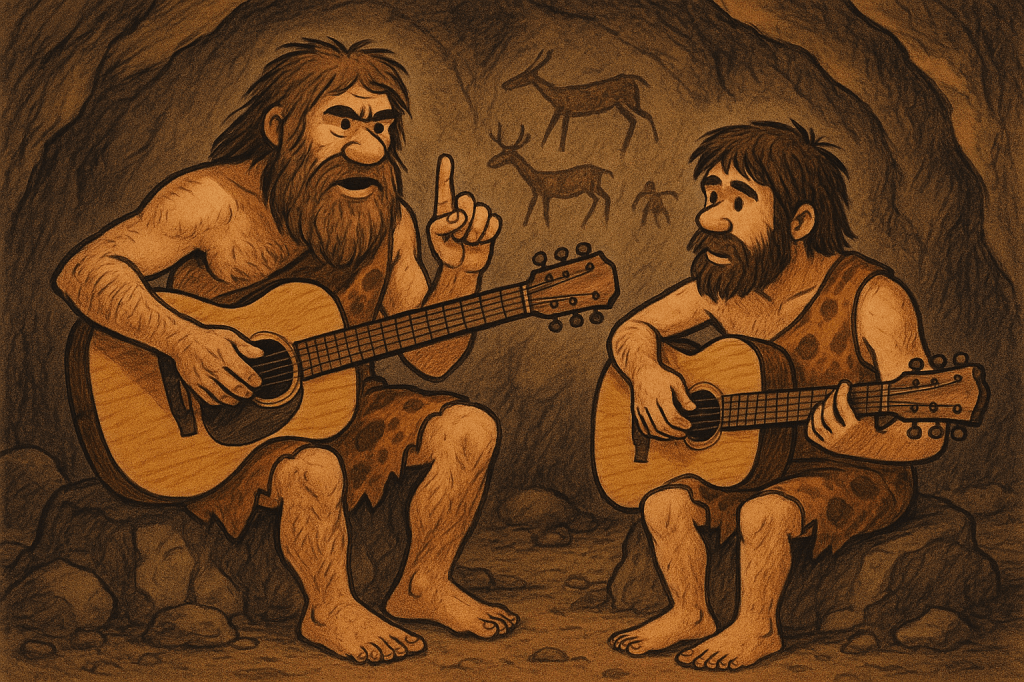
If we want to understand what’s happening in the brain of a modern-day guitarist, we need to begin our journey thousands of years ago. That’s because the brain we have today wasn’t shaped by the digital age, but by a much older hunter-gatherer past. The neural pathways that move our hands across the strings, help us follow a melody, or read musical notation weren’t originally designed for music. They are adaptations, repurposed versions of brain modules that evolved to handle much more basic tasks essential for survival.
According to evolutionary psychologists, all humans share a common mental architecture. This architecture is made up of specialized brain modules responsible for essential functions like language, mating, threat detection, and understanding social hierarchy. These modules began to develop during the Pleistocene era, the longest phase in human history, which began approximately 1.8 million years ago and ended around 10,000 years ago. What’s especially surprising is that, at the genetic level, these modules have remained largely unchanged ever since.
——————————————–
Cultural Repurposing of Cortical Maps
As proposed in the “Neuronal Recycling Hypothesis” proposed by Stanislas Dehaene and Laurent Cohen in their 2007 publication, new cultural skills are mapped onto evolutionarily older systems in the brain. These new functions make use of the preexisting structural and functional properties of those ancient neural pathways.
The region of the brain associated with reading, known as the Visual Word Form Area (VWFA), is located in the left occipito-temporal sulcus and is consistently activated during reading. It responds specifically to written words, not to spoken language. Research suggests that the brain doesn’t develop entirely new regions for cultural skills like reading. Instead, it repurposes and reorganizes existing neural systems—such as those originally involved in visual recognition or matching sounds with shapes—to support these new abilities.
Research has shown that the neural modules responsible for recognizing human faces are also involved when we distinguish between man-made objects like cars and trucks. Although these modules did not evolve to identify vehicles, it makes sense that they can do so by interpreting certain features such as headlights as eyes, the hood as a nose, and the grille as a mouth.
Writing systems have also evolved in ways that reflect the brain’s visual preferences shaped by evolution. For example, letters across many alphabets tend to consist of an average of three basic line components. These patterns closely resemble the visual features commonly found in natural objects, as noted in the work of Mark Changizi.
Similarly, the origins of music can also be linked to a uniquely human, top-down processing system. This process involves the use of preexisting auditory representations such as pitch, rhythm, and timbre to organize and process sound.
——————————————–
Bottom-Up Processing: This type of information processing begins with raw sensory input—such as sights or sounds—which is then analyzed by the brain to build higher-level perceptions and meaning. For example, when you hear a piece of music for the first time, your experience of its melody and rhythm is shaped entirely by the data your auditory system receives, without the influence of prior knowledge.
Top-Down Processing: In contrast, top-down processing starts with what the listener already brings to the experience: knowledge, expectations, attention, past experiences, and beliefs. These internal factors influence how sensory input is understood and organized. For instance, when you listen to a piece by your favorite composer, you’re more likely to focus closely and make sense of its musical structure based on what you already know and anticipate.
——————————————–
Guitar training also relies on the brain’s pre-existing systems for motor planning, sensorimotor coordination, and auditory feedback. These include:
- Motor Cortex & Basal Ganglia – Responsible for planning movements and supporting repetitive learning
- Cerebellum – Controls fine motor coordination and timing
- Auditory Cortex – Processes and refines incoming sound information
- Mirror Neuron System – Supports learning by watching and copying others
- Prefrontal Cortex – Regulates focus, attention, and problem-solving
- Nucleus Basalis – Plays a central role in sustaining attention
- Hippocampus – Enables memory formation and recall
——————————————–
None of these brain systems evolved specifically for playing the guitar. Yet all of them are activated together—and quite intensely—during guitar practice. One reason the early stages of learning guitar can feel so difficult is that we are, in a sense, ”updating” these neural systems for a new task.
Remember what it was like to learn how to write.
You had to figure out how to hold a pencil, practice endless lines and shapes, and write the same letters over and over until your handwriting started to take form.
What we do in guitar training is very similar.
So, if you’re able to read this article and you once learned how to write by hand, then yes, you can learn to play the guitar too.
——————————————–
Source:

Leave a comment