Absolute Pitch
Absolute pitch is the ability to recognize and name a musical note (like “C” or “A sharp”) without needing a reference tone. Someone with this ability can hear a random note and instantly say, “That’s D-sharp.” At a music school I used to work at, I met a piano teacher who had this skill. One day, I dropped my pen on the floor by accident. He smiled and said, “B-flat.” I was stunned. I jokingly asked, “Can you shoot lasers from your eyes too?” : )
When I looked into it a bit more, I found out that this amazing ability (absolute pitch) is seen in about 1 in 10,000 people and is largely shaped by genetics. It can’t be developed later through training or practice. To me, people with this ability seemed like Marvel or DC characters. They were part of a lucky group with the same “superpower” Mozart reportedly had.
This is exactly how a myth starts and spreads. Beliefs like this can make you underestimate your own potential or worse, stop you from ever picking up an instrument or exploring an art form you could’ve been great at, just because you placed limits on yourself before even trying.
But there is a bit of truth in this myth: talent does matter.
But not in the way you think.
——————————————–
Ayako Sakakibara’s Experiment
In 2014, music educator Ayako Sakakibara from the Ichionkai Music School in Tokyo carried out an eye-opening experiment with 24 children. These children were typical in the sense that they had not been born with absolute pitch; they couldn’t name a note just by hearing it.
The goal of the study was to train children between the ages of 2 and 6 to develop absolute pitch. The training consisted of 4 to 5 sessions per day, with each session including 20 to 25 trials. The program was designed to last for two years. Instruction began with the white keys on the piano (the notes of the C major scale) and gradually expanded to include the black keys, incorporating sharps and flats.
——————————————–
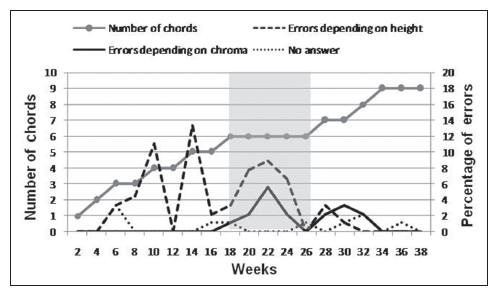
This graph illustrates the gradual progress observed over the course of several weeks. Errors are categorized using two well-known aspects of pitch perception. The first is tone height, which reflects the linear perception of pitch from low to high, based on frequency. The second is tone chroma, which refers to pitch classes that repeat across octaves. For example, all C notes in different octaves share the same chroma.Chord acquisition started to increase from the very first week and continued steadily until around week 18, when it reached a plateau. During this period, the participant was able to identify only six chords correctly over the following eight weeks. By week 28, one more chord was added, and from that point forward, the number of correctly identified chords began to rise again. By week 38, errors had decreased to a minimum, indicating a significant improvement in recognition accuracy.
——————————————–
As a result of the experiment, 22 out of 24 children successfully completed the training and acquired absolute pitch. The remaining two children left the study due to personal reasons. Among those who completed the program, some achieved the outcome in less than 1 year, while others did so within 1,5 years. In the end, every child who completed the training developed absolute pitch. This finding challenges the idea that absolute pitch is only natural or very rare.
She may not shoot lasers from her eyes, but I still remember the piano teacher with perfect pitch mentioning that she started music training at a very young age. Now I have a much clearer understanding of how crucial early education truly is.
Genetics certainly plays a role. The fact that some of the 22 children needed up to one and a half years to complete the training may reflect individual genetic differences, just as some people naturally build muscle more easily. Still, without training, muscles don’t grow.
——————————————–
The ability we’re talking about is the brain’s natural capacity to reorganize itself, known as neuroplasticity. The brain can create new connections, strengthen those that are regularly used, and eliminate those that are not. This capacity isn’t limited to childhood; it remains active throughout our lives.
Children aged two to six are often the focus since their brains change more easily during that time. Still, adults who stay mentally and physically active, challenge themselves intellectually, and keep their curiosity alive, also maintain a strong potential for neuroplasticity. While the days when your brain soaked up information like a sponge may be in the past, you can still achieve deeply rewarding results through determination, structure, attention, and focus.
Remember the article, “Is It Too Late At This Age?”
——————————————–
Music is not a gift you are born with.
The skills we have aren’t heavenly gifts, but the ability to develop skills is a gift in itself.
As far as we know, everyone is born with that ability.
You don’t need a special coctail of genes.
What really matters is combining your brain’s natural ability to build new connections with the right kind of training with conscious and purposeful practice.
You may not shoot lasers from your eyes, but you can make a guitar sound absolutely magical : )
——————————————–
——————————————–
Source:

Leave a comment