In the late 1990s, while exploring how musical training shapes the brain, Harvard neuroscientist Alvaro Pascual-Leone found himself asking an unexpected question:
Is it possible that just imagining a movement works as well as practicing it for real?
——————————————–
The experiment included two groups of people who had never played the piano before. Both groups were taught the same melody and shown exactly how to press the right keys. Then, they were split into two:
Physical practice group: These participants played the melody on a real digital piano for two hours a day, five days a week.
Mental practice group: These individuals sat in front of the same piano for the same amount of time, but without moving their fingers. Instead, they imagined themselves playing the melody and hearing each note in their minds.
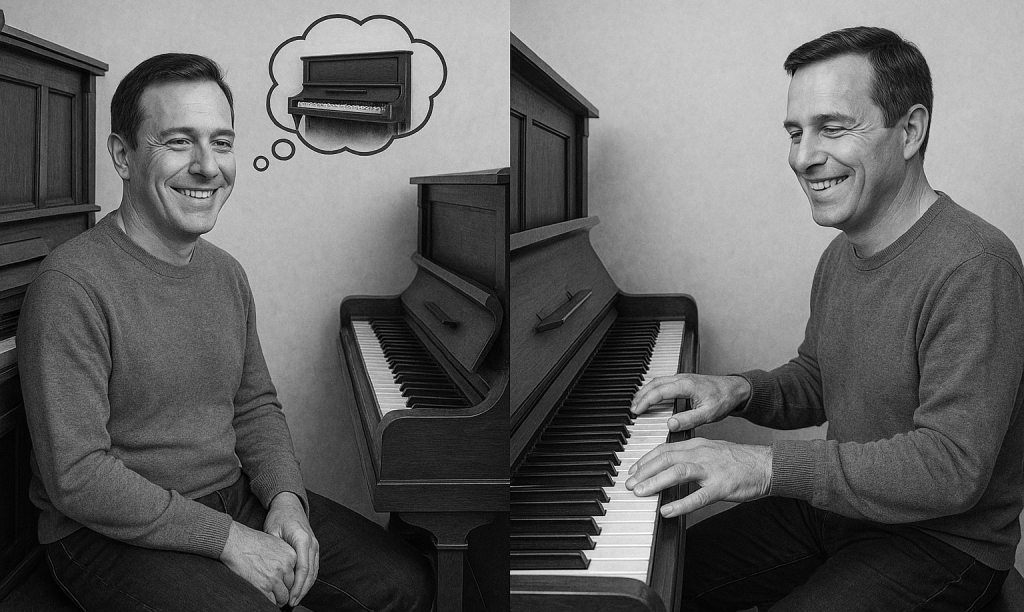
During the experiment, Pascual-Leone used transcranial magnetic stimulation (TMS) to map each participant’s motor cortex activity every day. At the end of the week, both groups were asked to physically play the melody they had practiced. Surprisingly, both groups could play it.
The changes seen in the motor cortex were similar in those who practiced on the piano and those who only imagined doing it. The mental practice group had strengthened the neural signals to their muscles using nothing but imagination. In other words, their motor system had rehearsed the movement as if it were real. Even though it all happened in their minds.

Both groups were asked to play the melody they had learned. As expected, the physical practice group showed clear improvement after five days, and their performance was solid. On the other hand, the mental practice group performed at a lower level compared to the physical group. However, after just two hours of actual physical practice, the mental group caught up to the level the physical group had reached in five days. This finding showed that mental rehearsal had already primed the brain for action, even before any real movement took place.1
——————————————–
The Brain Doesn’t Seperate Between Reality and Imagination
The most eye-opening finding from Pascual-Leone’s experiment was this:
The brain responds to an imagined experience almost the same way it responds to a real one. The motor cortex doesn’t only send commands to the muscles; it also mentally rehearses possible movements. That’s why mental practice can lead to real, lasting changes in the brain.
Toward the end of his career, concert pianist Glenn Gould increasingly turned to mental practice to prepare for recording sessions.2
When people close their eyes and clearly imagine the letter A, the primary visual cortex becomes active, just as if they were actually seeing it. Brain scans show that the same regions light up during both real actions and imagined ones.3 Here’s a simple experiment you can try right now: When you imagine writing your own name, the time it takes is almost exactly the same as when you write it on paper.4
In another experiment, participants either performed finger exercises, 15 repetitions every 20 seconds, and simply imagined doing the same movements. By the end of the study, those who trained physically increased their strength by 30%, while those who practiced mentally still saw a remarkable 22% improvement.5
One of the most advanced forms of mental practice is playing chess entirely in your mind, without a board or pieces. Anatoly Shcharansky, a computer expert, was imprisoned for nine years on charges of spying for the United States. He spent 400 of those days in a solitary cell, a cold and dark space barely three square meters in size. Staying that long in a solitary cell often leads to psychological collapse, because the brain depends on external stimulation to keep its cognitive systems active. Shcharansky kept his mind sharp by playing full games of mental chess. Remarkably, after his release, he managed to hold his own in a match against Garry Kasparov. Writer Stefan Zweig touched on a similar idea in his short novel Chess Story.
——————————————–
The same principle applies to playing the guitar. When you visualize finger positions, internalize the sounds, or mentally go over a passage with your eyes closed, your brain processes these experiences almost as if they were real. This is because most of the signals exchanged between the brain and the muscles are not about performing movement, but about preparing for it. Mental rehearsal activates this preparation system and primes the motor circuits for action.
Learning a melody with your brain before your fingers is like an actor memorizing lines before stepping on stage. Even when you’re physically tired or limited by your surroundings, mental practice helps you stay in the game.
Next time you find yourself on a business trip without your guitar or stuck in traffic, give it a try!
——————————————–
Source:
1- The Plastic Human Brain Cortex – Alvaro Pascual-Leone, Amir Amedi, Felipe Fregni, and Lotfi B. Merabet
2- The Song that Never Ends: Practicing Away from the Piano
3- https://www.nature.com/articles/35090055
4- https://pubmed.ncbi.nlm.nih.gov/2765170/
5- Strength increases from the motor program: comparison of training with maximal voluntary and imagined muscle contractions

Leave a comment