
Mastering a skill is often seen as something mysterious, almost magical, as if it depends on some hidden gift you’re born with that we can’t quite explain. There’s no denying the role of genetics and the environment we grow up in, but the truth is a little different.
The truth isn’t a magical transformation. It’s more like the steady path of a tortoise: slow, but always moving.
In an experiment by Pascual-Leone and colleagues (1995, 1996), healthy individuals were trained to perform a specific five-finger exercise on a piano keyboard. They were instructed to play the sequence with consistent timing and accuracy, striking the keys at equal intervals, in a steady rhythm. Participants practiced two hours a day for five days straight, using a metronome set to 60 bpm.

Throughout the experiment, participants’ motor cortices were mapped using transcranial magnetic stimulation (TMS) before and after each daily practice session. After each session, researchers observed a clear expansion in the cortical areas that control the finger muscles. Interestingly, this change only appeared after a short rest period of 20 to 30 minutes and it wasn’t visible in the scans taken just before each day’s practice. These results show that the brain’s motor maps can change quickly and temporarily.
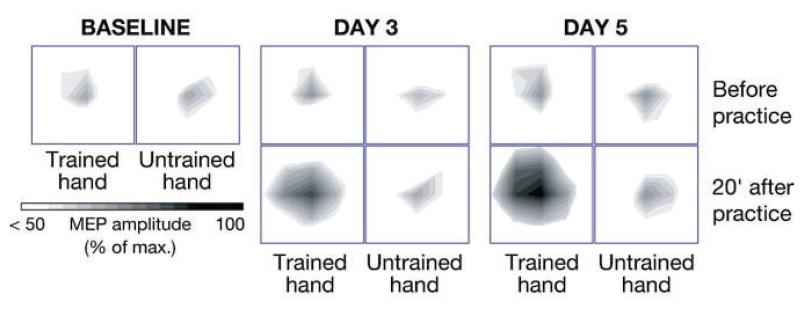
The figure above shows cortical output maps of the finger flexor muscles for both the trained and untrained hands of a representative participant. After practice, clear changes appeared in the trained hand’s map, while the untrained hand showed no change. Also note the striking differences in the trained hand’s cortical maps between days 3 and 5 of practice.
After five days of intensive practice, participants who had reached a high level of performance were split into two groups for a four-week follow-up. The first group continued practicing, while the second stopped entirely. TMS scans showed that in the first group, measurements taken on Fridays increased at first, then began to decline. Interestingly, Monday measurements kept rising steadily week after week. In contrast, the second group’s maps returned to baseline after just one week and stayed there for the rest of the study.
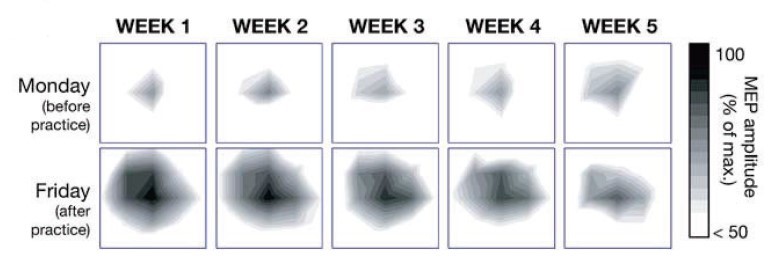
The figure above shows daily cortical output maps of the finger flexor muscles, recorded from a representative subject over five weeks during a five-finger exercise. The maps reveal two overlapping processes: one causes rapid changes from Monday to Friday, while the other leads to slower, more lasting changes seen in the Monday scans over time.
——————————————–
These findings suggest that brain plasticity is fast but short-lived at first. However, when the skill is practiced consistently over time, the pattern of cortical activation begins to shift. Over time, new regions take on the task and leading to more long-term structural changes.
Pascual-Leone believed that the differences between Monday and Friday results reflected two distinct forms of plasticity. The rapid changes seen on Fridays were linked to the strengthening of existing neural connections and the unmasking of hidden pathways. In contrast, the slower, more lasting changes observed on Mondays suggested the formation of entirely new structures, likely involving the growth of new neural connections and synapses.
Understanding this “hare (Friday) vs. turtle (Monday)” effect helps us see what it really takes to master a new skill. Making progress after a short burst of practice is fairly easy, most likely because we’re reinforcing existing synaptic connections. But the progress made at this stage doesn’t last long, because it’s based on temporary connections that fade quickly. To make real progress and truly retain a skill, what’s needed is slow, steady training; this kind of practice gradually builds new neural connections over time.

If you feel like you’re not making steady progress, or everything you learn slips away too quickly, just keep practicing until the Monday effect starts to show. In the piano exercise study, this took about five weeks. The difference between Friday and Monday results shows why slow, steady learners often do better than fast learners who don’t keep practicing.
I can assure you that with consistent and focused practice, pieces that once felt impossible will become simple warm-up exercises. Even if you think you’re not naturally gifted.
You can’t choose your genes or the environment you grew up in, but you can choose to practice every day.
And in the end, you know:
The Tortoise Won The Race.
——————————————–
Source:

Leave a comment